How to Find Undervalued European Stocks Using Insider Data
Finding undervalued European stocks has never been more difficult — yet insider transaction data offers one of the most direct signals available to retail and professional investors alike. Here is how to use it.
Finding undervalued European stocks has never been more difficult. On one hand, Europe remains home to some of the world's most attractive businesses. Many trade at significantly lower valuations than comparable U.S. companies. On the other hand, information is fragmented across dozens of countries, languages, stock exchanges, and regulatory systems. As a result, many investors overlook opportunities that are hiding in plain sight. One of the most effective ways to uncover these opportunities is by following insider transactions. When executives, board members, and founders buy shares with their own money, they are sending a signal to the market. While insider buying is never a guarantee of future performance, it can provide valuable insight into how management views the company's valuation and prospects.
Why Insider Buying Matters
Corporate insiders know their business better than anyone else. They understand current trading conditions, upcoming product launches, customer demand trends, competitive pressures, and capital allocation plans. Most importantly, they know whether the current share price reflects reality. While insiders can sell shares for many reasons — such as diversification or tax planning — they typically buy shares for one reason: they believe the stock is worth more than the current market price. This is why insider buying has long been used as a supporting indicator by professional investors and value investors alike. When management is willing to commit personal capital, it often deserves attention.
Europe's Hidden Advantage
The European stock market offers a unique opportunity for investors willing to do the work. Unlike the United States, where thousands of analysts cover large-cap companies, many European businesses receive very little attention. This creates information inefficiencies. A Swedish small-cap, a Belgian industrial company, or a South Korean technology supplier may have only a handful of analysts following the stock. Yet management still reports insider transactions to regulators. In many cases, insider activity can reveal opportunities long before they appear on research reports or financial media headlines.
What Makes Insider Buying Meaningful?
Not all insider purchases carry the same weight. Here are several factors investors should consider:
1. Purchase Size
A CEO buying €500 worth of shares is very different from a CEO investing €500,000 of personal capital. Larger purchases generally indicate stronger conviction.
2. Multiple Insiders Buying (Cluster Buying)
One insider buying shares is interesting. Three or four insiders buying within a short period is often far more significant. This is commonly referred to as cluster buying. When several executives independently decide the stock is attractive, investors should pay close attention. InsidersAlpha detects cluster buying automatically across all 15 tracked markets.
3. Buying After a Large Decline
One of the strongest signals occurs when insiders buy after a substantial share price decline. Management may believe the market has become overly pessimistic and that the stock is trading below intrinsic value. InsidersAlpha tracks this price dip signal across all covered markets.
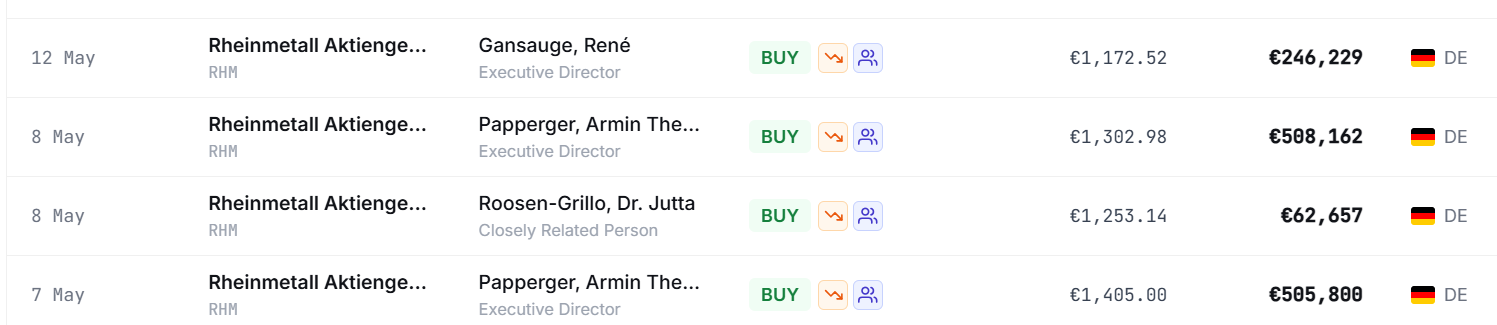
Rheinmetall AG (RHM) — insider purchases recorded in May 2026 following a period of share price weakness. Multiple directors committed personal capital at lower prices, a textbook price-dip buying pattern tracked automatically by InsidersAlpha.
4. Consistent Accumulation
Repeated purchases over several weeks or months can sometimes be more informative than a single large transaction. This suggests management continues to view the shares as attractive at current prices. InsidersAlpha flags this as a repetitive buying signal.
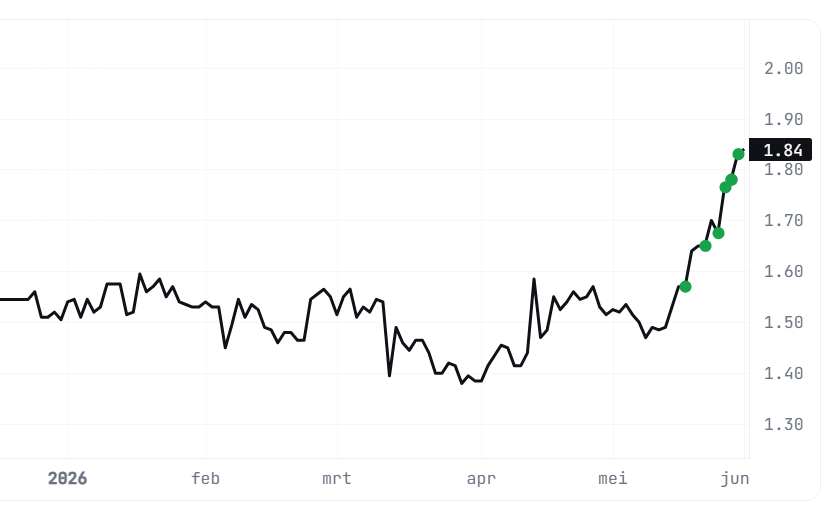
NanoRepro AG (NRP) — the chart illustrates consistent insider accumulation across multiple transaction dates, with directors repeatedly adding to their positions at similar price levels. This pattern of sustained buying is one of the most reliable signals InsidersAlpha tracks.
Combining Insider Data with Fundamental Analysis
Insider buying should never be used in isolation. The most successful investors combine insider activity with traditional value investing principles. Questions worth asking include: Is the company profitable? Does it generate free cash flow? Is the balance sheet healthy? Is the valuation attractive compared to peers? Is management aligned with shareholders? When insider buying supports an already attractive investment case, confidence in the opportunity often increases.
The Challenge of Tracking European Insider Transactions
The biggest obstacle for investors is not understanding insider buying — the challenge is finding the data. European insider disclosures are spread across numerous regulators and exchanges including Germany (BaFin), France (AMF), Sweden (Finansinspektionen), Denmark, Finland, Belgium (FSMA), Netherlands (AFM), Norway, Italy, Spain (CNMV), Poland (GPW/KNF), and South Korea (DART). Each market uses different reporting formats and disclosure systems. Tracking them manually is extremely time-consuming. This fragmentation is precisely why many investors miss valuable opportunities.
Using Technology to Find Insider Opportunities Faster
Rather than searching dozens of regulatory databases individually, investors can use specialized platforms that aggregate insider transactions into a single database. At InsidersAlpha, we built the platform because we faced this exact problem ourselves. As international value investors, we wanted a way to track insider buying across Europe, South Korea, and Singapore without manually reviewing dozens of disclosure websites every day. The platform aggregates insider transactions across 18 markets, applies proprietary insider signals, and helps investors identify unusual buying activity more efficiently. Instead of spending hours searching through fragmented filings, investors can focus on what matters most: analyzing businesses and making investment decisions.
Free, no account required. View live insider transactions, signals, and conviction scores.
Final Thoughts
Finding undervalued European stocks requires an edge. One of the most overlooked sources of information remains insider buying. When executives and directors commit their own money, they provide a valuable signal that can complement traditional valuation analysis. Insider activity should never replace fundamental research, but it can help investors narrow their focus and uncover opportunities that the broader market may still be overlooking. For investors searching beyond the crowded U.S. market, insider data offers a practical way to discover potentially undervalued European stocks before they attract wider attention.
Frequently Asked Questions
What is insider buying in stocks?
Insider buying refers to purchases of company shares by corporate insiders — executives, board members, and major shareholders — using their own personal capital. In Europe, these transactions must be disclosed under MAR Article 19 within 3 business days of the transaction.
Is insider buying a reliable indicator?
Insider buying is not a guarantee of future performance, but academic research has consistently found that insider purchases generate above-average returns over 3–12 month horizons. Cluster buying — where multiple insiders buy simultaneously — has shown the strongest predictive power. Insider buy signals tracked on InsidersAlpha have averaged +8.4% returns at 30 days across 1,092 signals.
How can I track insider transactions in Europe?
European insider transactions are disclosed to national regulators including BaFin (Germany), AMF (France), Finansinspektionen (Sweden), and others. InsidersAlpha aggregates disclosures from 18 markets into a single searchable database, updated daily and free to use.
Which European countries disclose insider transactions?
All EU member states require insider disclosure under MAR Article 19. InsidersAlpha currently tracks Germany, France, Spain, Italy, Netherlands, Belgium, Poland, Sweden, Denmark, Finland, Norway, Switzerland, Portugal, Luxembourg, and the United Kingdom, plus South Korea.
What is cluster buying?
Cluster buying occurs when multiple different insiders at the same company purchase shares within a 14-day window. This is considered one of the strongest insider signals because it suggests independent conviction from several executives simultaneously.
Can insider buying help identify undervalued stocks?
Insider buying can serve as a useful supporting indicator when combined with fundamental analysis. When management commits personal capital after a share price decline, it may suggest they believe the market has undervalued the business. InsidersAlpha tracks this bought-after-price-decline signal across all 15 covered markets.